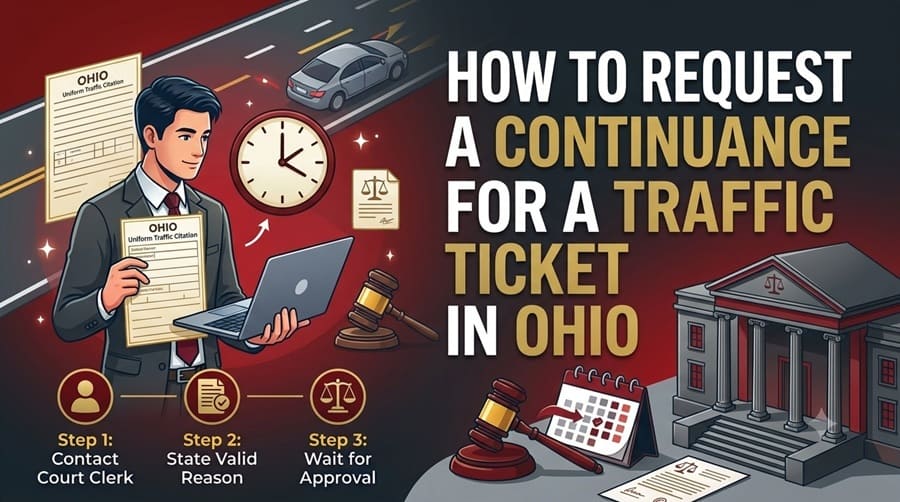
How to request a continuance for a traffic ticket in Ohio?
Quick answer: To request a continuance for a traffic ticket in Ohio, contact the court listed on your citation before your scheduled hearing date. You can call the clerk’s office, submit a written motion, or have a traffic attorney file on your behalf. Courts typically grant continuances for valid reasons such as scheduling conflicts, illness, or time needed to secure legal representation.
Getting a traffic ticket in Ohio is stressful enough. Then you look at the court date printed on the citation and realize you have a work obligation, a medical appointment, or simply not enough time to find an attorney. That’s where a continuance comes in.
A continuance is a formal postponement of your court date. Ohio courts grant them regularly in traffic cases, and knowing how to request one correctly can give you the breathing room you need to build a proper defense, or at least show up prepared.
This guide explains what a continuance is, how to request one, when it makes sense to use one strategically, and whether contesting your speeding ticket in the first place is worth the effort.
What is a continuance in a traffic case?
A continuance is a court-approved delay of a scheduled hearing or trial date. In traffic cases across Ohio, including those handled by Franklin County Municipal Court and local mayor’s courts, continuances are a routine part of the process. Judges and magistrates understand that defendants need time to consult with attorneys, gather evidence, or resolve scheduling conflicts.
Importantly, a continuance does not dismiss your ticket. It simply moves the date. What it does give you is time to hire a Columbus speeding ticket lawyer, review the evidence, and develop a defense strategy before you step foot in a courtroom.
The “Speedy Trial Waiver” Warning
It is important to understand that when a driver requests a continuance, they are legally pausing the clock and waiving their constitutional right to a speedy trial for the duration of that delay. While a “speedy trial waiver” is a completely standard procedural step in Ohio traffic defense, it must be done knowingly as part of your overall case strategy.
How to request a continuance for a traffic ticket in Ohio
The process varies slightly depending on which court is handling your case, but the general steps are consistent across Ohio jurisdictions.
Step 1: Identify the correct court
Check your citation carefully. Ohio traffic tickets are not always handled by the county’s main municipal court. Depending on where you were pulled over, your case may be assigned to a local mayor’s court like those in Dublin, Westerville, Gahanna, or Reynoldsburg. Each court has its own procedures for requesting continuances.
Step 2: Contact the court clerk before your hearing date
Call the clerk’s office as soon as you know you need a continuance. Do not wait until the day of your hearing. Most Ohio courts require requests to be made in advance. Last-minute requests are far less likely to be granted.
When you call, be ready to provide:
- Your full name
- Your case or citation number
- Your scheduled court date
- A brief reason for the request
Step 3: Submit a written motion (if required)
Some courts, particularly Franklin County Municipal Court, may require you to file a formal written motion for a continuance. This document typically includes your name, case number, current hearing date, the proposed new date (or a request for the court to set one), and the reason for the request.
If you are working with a Columbus traffic ticket attorney, they can file this motion on your behalf. In many traffic cases, your attorney can also waive your appearance entirely, meaning you never have to go to court at all.
Step 4: Follow up to confirm
Never assume your continuance was granted just because you requested it. Call the clerk’s office to confirm the new date and get it in writing if possible. Missing a court date, even if you believe your continuance was approved, can result in a warrant being issued for your arrest.
The Ohio Proof of Insurance Requirement
Crucial Practical Reminder: Bring your physical auto insurance card or digital proof of coverage to court!
Under Ohio’s Financial Responsibility law, you are required to show proof of insurance for the date and time you were pulled over. If the law enforcement officer marked “NO” under the financial responsibility (FR) section on your ticket, you will want to present proof of insurance to the court clerk to avoid issues with the Ohio BMV. If insurance cannot be proven, a license suspension will result.
Is it worth contesting a speeding ticket in Ohio?
This is the question most drivers ask before deciding whether to simply pay the fine and move on. The short answer: for most Ohio drivers, contesting a speeding ticket is absolutely worth it.
Here’s why. Paying a ticket is legally equivalent to pleading guilty. That guilty plea triggers points on your Ohio BMV driving record, and those points set off a chain reaction.
Under Ohio Revised Code § 4511.21, speeding violations carry the following point values:
- 4 points – Traveling 30 mph or more over the posted limit
- 2 points – Traveling 6–29 mph over the limit in a zone below 55 mph
- 2 points – Traveling 11–29 mph over the limit in a zone of 55 mph or higher
- 0 points (fines only) – Traveling 1–5 mph over any posted limit
Accumulating 12 points within two years results in an automatic six-month license suspension. But the more immediate consequence for most drivers is the insurance penalty. A single moving violation in Ohio typically causes auto insurance premiums to increase by 20% to 30%. At average Ohio premium levels, that translates to $750 to $1,250 in extra insurance costs over three to five years, all from one ticket.
When a skilled traffic defense attorney can negotiate a reduction to a non-moving violation (such as a minor equipment infraction carrying zero points), the financial case for fighting the ticket becomes clear.
How a continuance for dismissal works in speeding ticket cases
One strategic reason to request a continuance is to create time for a “continuance for dismissal” arrangement. This is sometimes available in Ohio traffic cases where the ticket gets dismissed after a specified period if the defendant stays out of trouble.
This outcome is not guaranteed and depends heavily on the specific court, the prosecutor, and the nature of the citation. It is more likely to be available in mayor’s courts than in Franklin County Municipal Court, and it typically requires negotiation by an experienced attorney who knows the local prosecutors and their tendencies.
If you are hoping for a continuance-based dismissal on a speeding ticket, the first step is consulting a Columbus speeding ticket lawyer who appears regularly in the court handling your case. Local knowledge matters. What works in one jurisdiction may not work in another.
What happens if you miss your court date in Ohio?
Missing a court date without requesting a continuance is a serious mistake. Ohio courts can issue a bench warrant for your arrest, suspend your driving privileges, and assess additional fines. If you have already missed your date, contact a traffic attorney immediately to discuss your options before the situation escalates any further.
Should you hire a Columbus speeding ticket lawyer to handle your continuance?
For a simple continuance request, you may be able to handle it yourself by calling the clerk’s office. But if your goal is to use that extra time to build a defense, or to pursue a reduction or dismissal, working with a Columbus speeding ticket lawyer is a significant advantage.
Attorney Colin Maher of The Maher Law Firm appears almost daily in Franklin County Municipal Court and surrounding mayor’s courts. He can file your continuance motion or appear in court on your behalf. He offers free consultations and transparent flat-fee pricing, so you know exactly what representation costs before committing.
Reach The Maher Law Firm at (614) 205-2208 or visit The Maher Law Firm to schedule a free consultation.
Frequently asked questions about continuances for traffic cases in Ohio
How many continuances can you get for a traffic ticket in Ohio?
Ohio courts have broad discretion over how many continuances to grant. In practice, most courts will allow one or two continuances for valid reasons. Repeated requests without strong justification are typically denied. Courts prioritize moving cases forward, so each request should be accompanied by a legitimate reason.
Can a continuance lead to a dismissal of a speeding ticket in Ohio?
In some Ohio jurisdictions, a continuance can be structured as part of an agreement where the ticket is dismissed after a defined period if the driver commits no further violations. This is not a guaranteed outcome and typically requires attorney negotiation with the local prosecutor.
How long does a continuance delay your Ohio traffic court date?
The length of a continuance depends on the court’s docket and the reason for the request. A typical continuance in Ohio traffic cases moves the hearing by 30 days, though this varies by court and circumstance.
Does requesting a continuance hurt your case?
No. Requesting a continuance is a standard and widely accepted part of the Ohio traffic court process. Judges routinely grant them and do not draw negative inferences from a reasonable request. The key is to request it properly and in advance.
Can a lawyer request a continuance on your behalf in Ohio?
Yes. An Ohio traffic attorney can file a motion for continuance on your behalf and, in most standard traffic cases, can appear in court so you do not have to attend at all. This is one of the most practical advantages of hiring legal representation for a traffic ticket.
Is it worth hiring a lawyer just to request a continuance?
A continuance alone is a procedural step, not a legal strategy. Hiring a Columbus traffic ticket lawyer is worth considering not just for the continuance, but for what happens after like building a defense, negotiating with prosecutors, and pursuing the best possible outcome for your case.
RECENT POSTS
-
How to request a continuance for a traffic ticket in Ohio?
04 Aug 2026
-
Rear-Seat Passenger Seatbelt Fines Is the Driver Liable?
16 Jul 2026
-
Will My Insurance Increase for an Impeding Traffic Ticket in Columbus Ohio?
15 Jun 2026
-
What Is the Legal Limit for Alcohol in Ohio?
23 Apr 2026
-
Understand Drug Paraphernalia Charges in Ohio
06 Mar 2026
-
How To Dismiss a Traffic Ticket in Columbus, Ohio
04 Feb 2026
BLOG CATEGORIES
-
Weapons
3 Posts
-
Drugs
23 Posts
-
DUI
197 Posts
-
Current Events
1 Posts
-
Expungements
2 Posts
-
News
18 Posts
-
Criminal Defense
45 Posts
-
Traffic
132 Posts